Home Registra Services About Nasaon Chinasa Joyce Onwe Blog Get Started

Nasaon builds, secures and manages the systems that institutions run on.

Student information portals, academic journal platforms and custom AI — built from scratch, secured, and kept running.

Student Information Portals Admissions Systems Computer-Based Examinations Student Information Portals Admissions Systems Computer-Based Examinations
Academic Journal Platforms Payment Gateway Integration Custom AI Agents Academic Journal Platforms Payment Gateway Integration Custom AI Agents

Tell us what problem you are trying to solve, and we will help you figure it out.

Start a conversation
Our product

One system, from application
to clearance

Registra runs the full student lifecycle — undergraduate, postgraduate and every other academic programme — admissions, student records, fees on Remita and Paystack, computer-based examinations, results, transcripts and clearance. Each stage hands off to the next, so a candidate admitted in July is a registered student in August without anyone retyping a name. Below is how one part of it works.

Departmental board, faculty board and Senate approval happen the way they always have. Registra takes over the moment the approved result has to move — and makes sure the version students see is the version that was approved.
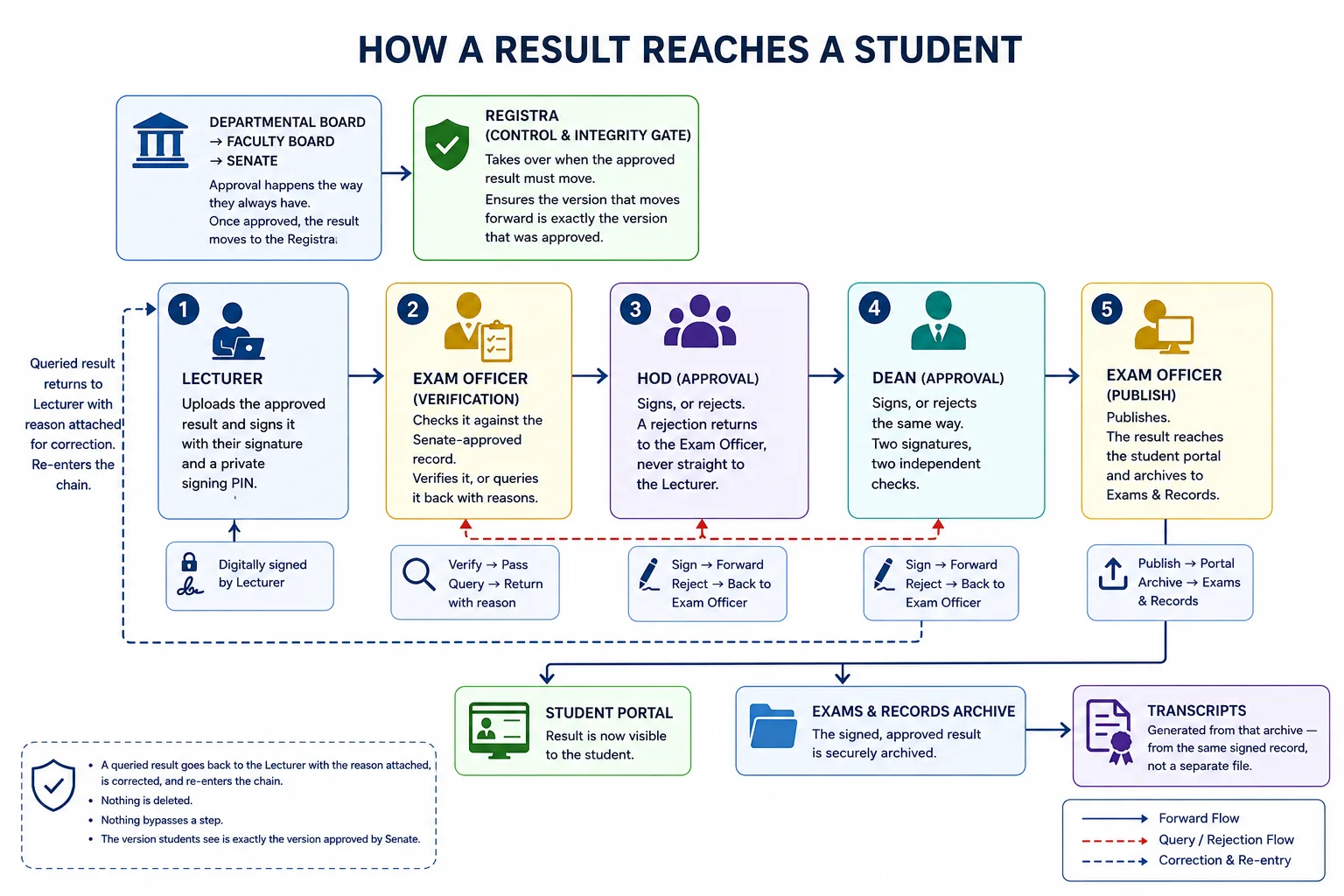
How a result reaches a student: board and Senate approval, then lecturer upload and signing, exam officer verification against the Senate-approved record, HOD and dean signatures, exam officer publication to the student portal and archive, and transcripts generated from that archive.
  1. Lecturer

    Uploads the approved result and signs it with their signature and a private signing PIN.

  2. Exam Officer

    Checks it against the Senate-approved record. Verifies it, or queries it back with reasons.

  3. HOD

    Signs, or rejects. A rejection returns to the Exam Officer, never straight to the lecturer.

  4. Dean

    Signs, or rejects the same way. Two signatures, two independent checks.

  5. Exam Officer

    Publishes. The result reaches the student portal and archives to Exams & Records.

  6. Transcripts

    Generated from that archive — from the same signed record, not a separate file.

A queried result goes back to the lecturer with the reason attached, is corrected, and re-enters the chain. Nothing is deleted and nothing bypasses a step.


Who we work with

The institutions
who trust us

Real systems, on their own domains, in daily use — universities running admissions, records and examinations, and an open-access journal built from nothing to indexed and minting DOIs.

Also built here

Custom software,
not templates

AI agents and chatbots

Built from scratch around how an institution actually works, not a wrapper on a generic assistant.

Institutional websites

Faculty, departmental and corporate sites — custom-built, secured, and structured so search engines can read them.

Web applications and databases

Internal systems for organisations that have outgrown spreadsheets and shared drives.

Working together

How an engagement
actually runs

  1. We look at what you have

    Existing systems, where records live now, and which processes are still on paper.

  2. We scope one thing first

    Usually admissions, because it has a deadline and the pain is measurable. Not a three-year platform plan.

  3. We build it and put it on your domain

    Your subdomain, your branding, your data. Not a tenant on someone else's platform.

  4. We stay through the first cycle

    The first admissions run or exam diet is when problems surface. That is when we are most available.

Tell us what you are
trying to run

Admissions cycle coming up, a journal that has stalled, records still in spreadsheets — say what it is and we will tell you honestly whether we can help.